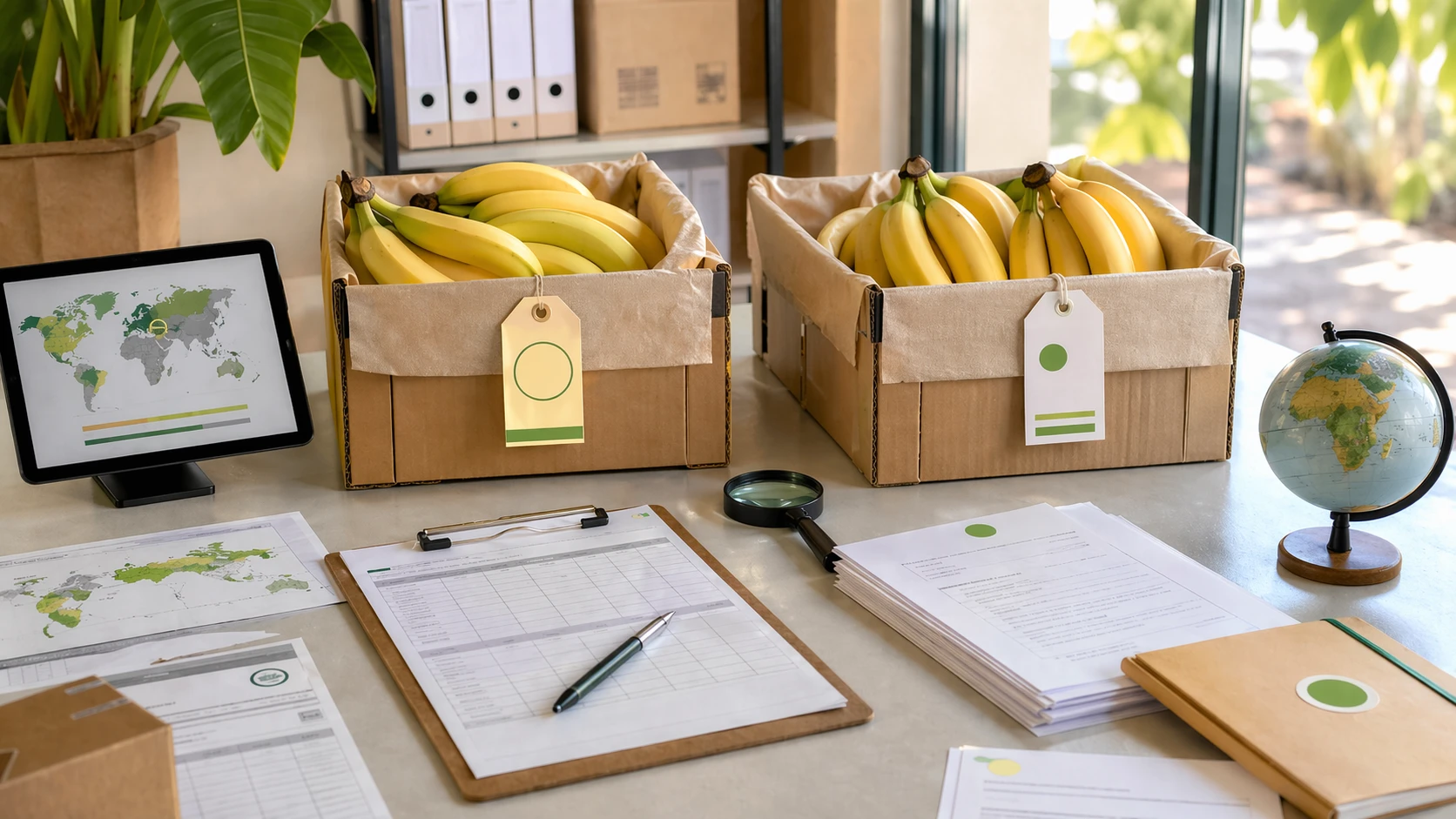
On May 13, 2025, Cadena SER reported that Spain's Guardia Civil was investigating a company in Alicante for selling tonnes of bananas as Plátano de Canarias.
According to the report, during 2023 the company sold almost 2,000 tonnes of bananas, and part of that volume was allegedly marketed illegally as Plátano de Canarias PGI. The case began after a complaint by the Association of Producers of Plátano de Canarias, which warned that the company was selling island bananas despite having its authorization to market them suspended.
The SEPRONA investigation found, according to the same source, that several batches of bananas from Madeira had been sold as Plátano de Canarias. The report also states that documents and invoices were allegedly falsified, while commercialization was hidden from both the certification body and the administration.
Why this case matters
This kind of fraud does not affect only one product. It affects trust in the whole protected-origin system.
A Protected Geographical Indication is not just a visible mark on a shelf. It is a promise of origin, control and differentiation. If a cheaper product can be presented as protected product through manipulated documentation or weak traceability, the damage is not limited to the consumer. It also affects legitimate producers who comply with the rules and compete with a higher real cost.
The Plátano de Canarias case is especially clear because economic value is directly linked to origin. According to Cadena SER, Plátano de Canarias PGI sells for about twice the price of banana. That makes the declared origin a critical part of the commercial value.
The operational friction
The underlying question is not only whether a label was correct.
The important question is whether the chain could prove:
- which product entered the facilities
- where it came from
- who sold it and to whom
- under which authorization it was marketed
- which documents accompanied each operation
- and how the physical product, invoices, certification and declared origin were connected
When those pieces are not connected in a defensible way, fraud can exploit the gap between documentation and evidence.
An organization may have invoices, delivery notes, labels and records. But if those elements do not form a coherent, attributable and reviewable history, they remain loose pieces. Loose pieces are much easier to manipulate, hide or reinterpret when an inspection appears.
The Averiun reading
For Averiun, this case illustrates a core point: having documentation is not the same as having verifiable evidence.
Useful traceability is not only about knowing that a document exists somewhere in the chain. It is about being able to support the sequence of relevant facts: product entry, declared origin, change of custody, commercial authorization, certification, distribution and sale.
That sequence needs integrity, authorship, context and rules. It also needs selective sharing, because not every actor should see everything, but relevant third parties must be able to verify what they need.
Averiun does not replace the certification body or the administration. Nor does it claim that technology can automatically detect every fraud. Its value appears elsewhere: reinforcing the part of the data that needs to hold up as evidence when origin, authorization or a commercial claim are critical.
Conclusion
The case of bananas sold as Plátano de Canarias is a reminder that protected origin is not defended only on the package.
It is defended across the entire chain that makes that package credible: records, authorizations, custody, documents, actors and controls that can be reviewed without depending on late reconstruction.
When origin is part of the value, the gap between having paperwork and being able to prove facts becomes decisive.
Sources

Written by
Sergio Lugo· CEO
Writes about traceability, operations, and how data veracity becomes a real competitive advantage.


