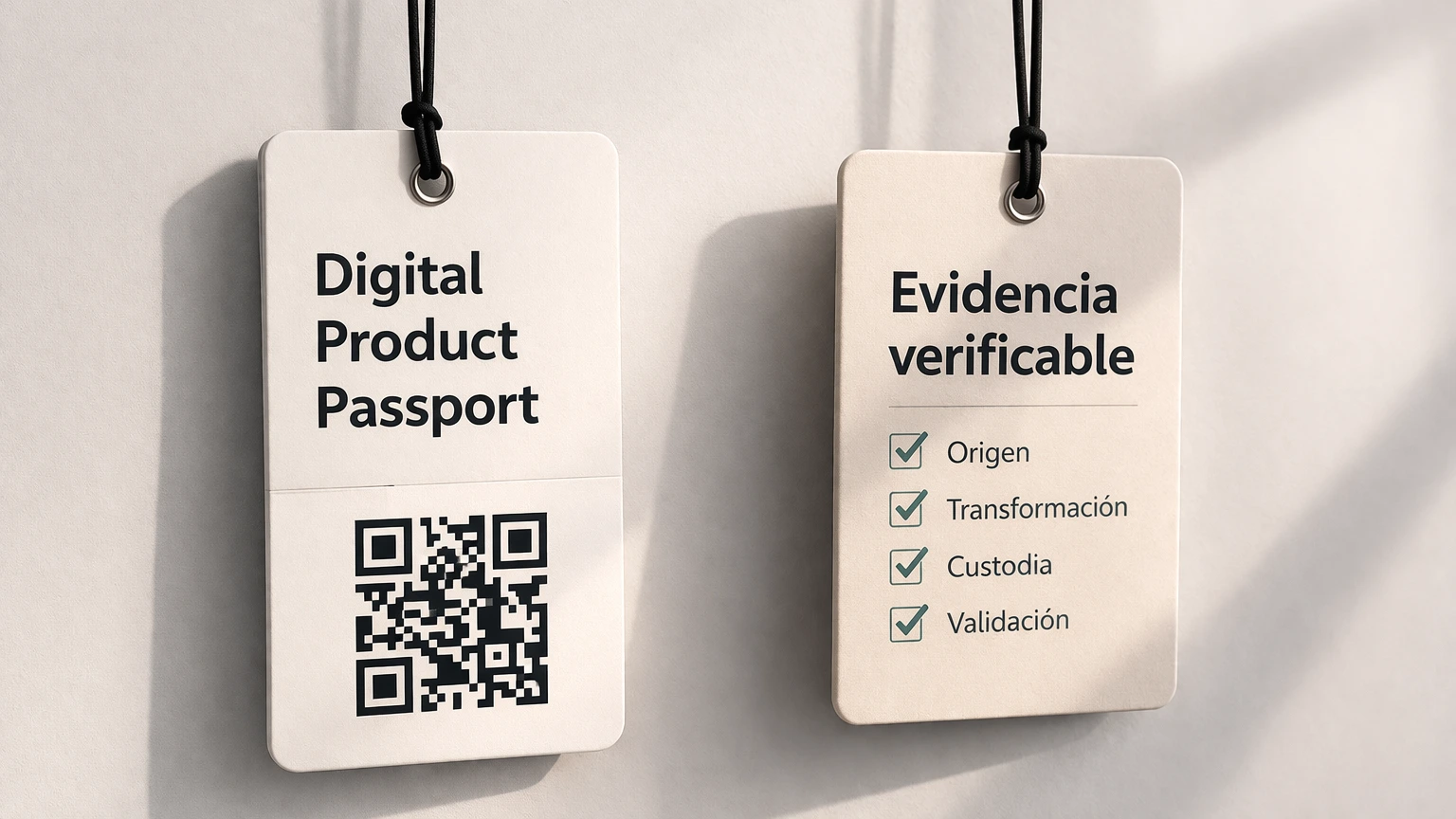
The Digital Product Passport is becoming one of the clearest signals of where the European market is heading: it is no longer enough to make product information more visible. It will increasingly matter whether that information can be supported in front of third parties. That is the difference that really matters.
In theory, a digital passport can bring together data about composition, origin, repairability, circularity, or other relevant attributes. But the real value will not lie in accumulating information or publishing a better-looking product sheet. It will lie in the ability to show that what appears there is backed by a coherent history, clear authorship, and a verifiable sequence. In other words: it is not only about declaring something, but about being able to defend what is declared.
That point changes the conversation quite a lot. For years, many organizations have made progress in document digitization, reporting, and data consolidation. Even so, in many supply chains there is still an obvious gap between having information and being able to demonstrate facts. The data exists. The documents exist too. What is often missing is a sufficiently ordered evidentiary base when multiple actors, different systems, and heterogeneous formats are involved. That is where traceability stops being a matter of visibility and starts becoming a matter of evidence.
The real shift: from digital sheet to verifiable evidence
The discussion around the Digital Product Passport can easily be reduced to interface, access, or user experience questions: what information each party will see, how it will be consulted, what role the QR code will play, or how the sheet will be structured. All of that matters, but it does not exhaust the problem.
The underlying issue is different: what traceability architecture can sustain that information when it needs to be reviewed, audited, or contrasted. Because a passport without an evidentiary base runs the risk of becoming an additional layer of well-presented documentation that turns weak the moment something needs to be verified rigorously.
And that moment will come. Not only because of regulatory pressure, but because of commercial pressure, audits, certification processes, third-party review, or the need to defend claims before customers, public bodies, or supply-chain partners. In that context, the difference between available information and verifiable evidence stops being semantic. It becomes operational.
Publishing better is not the same as proving better
There is a common confusion in many digitization processes: assuming that organizing documents or publishing more data means the proof problem has already been solved. That is not always true.
A company may have certificates, declarations, internal records, and multiple data sources associated with a product. But if that information is fragmented, depends on different actors, and does not preserve the sequence of what happened well enough, defending a specific attribute can still be difficult. The same happens when it is not clear who recorded what, under which rules, or with what documentary support.
That is why the Digital Product Passport should not be read only as a visibility obligation. It also raises the level of demand regarding the quality of the traceability that supports what is visible. And that forces organizations to look beyond the final document:
- toward the integrity of the historical record
- toward data governance
- toward the ability to reconstruct a meaningful chain of facts
Sharing evidence should not mean exposing the whole operation
There is another important dimension as well. In many sectors, improving trust does not mean opening all data or exposing the entire operation. It means being able to share the necessary evidence with the right level of control.
That nuance is critical. As traceability requirements grow, so does the need to share information among manufacturers, suppliers, certifiers, customers, or authorities. But sharing better should not mean losing control over all sensitive process information. Maturity lies in being able to prove what is necessary without exposing more than is necessary.
From that perspective, the value is not only in storing or displaying data, but in structuring it in a way that allows review, validation, and selective sharing. That is an important distinction for any organization operating in multi-actor chains that needs to sustain claims, prepare audits, or respond to external reviews with less friction.
What the DPP really reveals underneath
Beyond the passport itself, what this regulatory evolution reveals is a broader shift: the market is moving toward models in which claims alone carry less weight and the ability to demonstrate carries more.
That affects how data is prepared, how actors are connected, how the context of each record is preserved, and how a sufficiently solid chain of custody is built to withstand serious review. In that sense, the DPP is not only a debate about product digitization. It is also a debate about evidence, governance, and defensible traceability.
This is where many organizations may discover that digitizing documents was not enough. Because the challenge will not simply be to have more information around the product, but to have a foundation capable of supporting that information when it truly matters to prove something.
The question that really matters
The core question, then, is not whether more data will be available. The question is whether that data will be able to stand up with coherence, support, and control when audits, compliance, certification, or third-party review come into play. And that difference is going to become increasingly decisive.

Written by
Sergio Lugo· CEO
Writes about traceability, operations, and how data veracity becomes a real competitive advantage.


