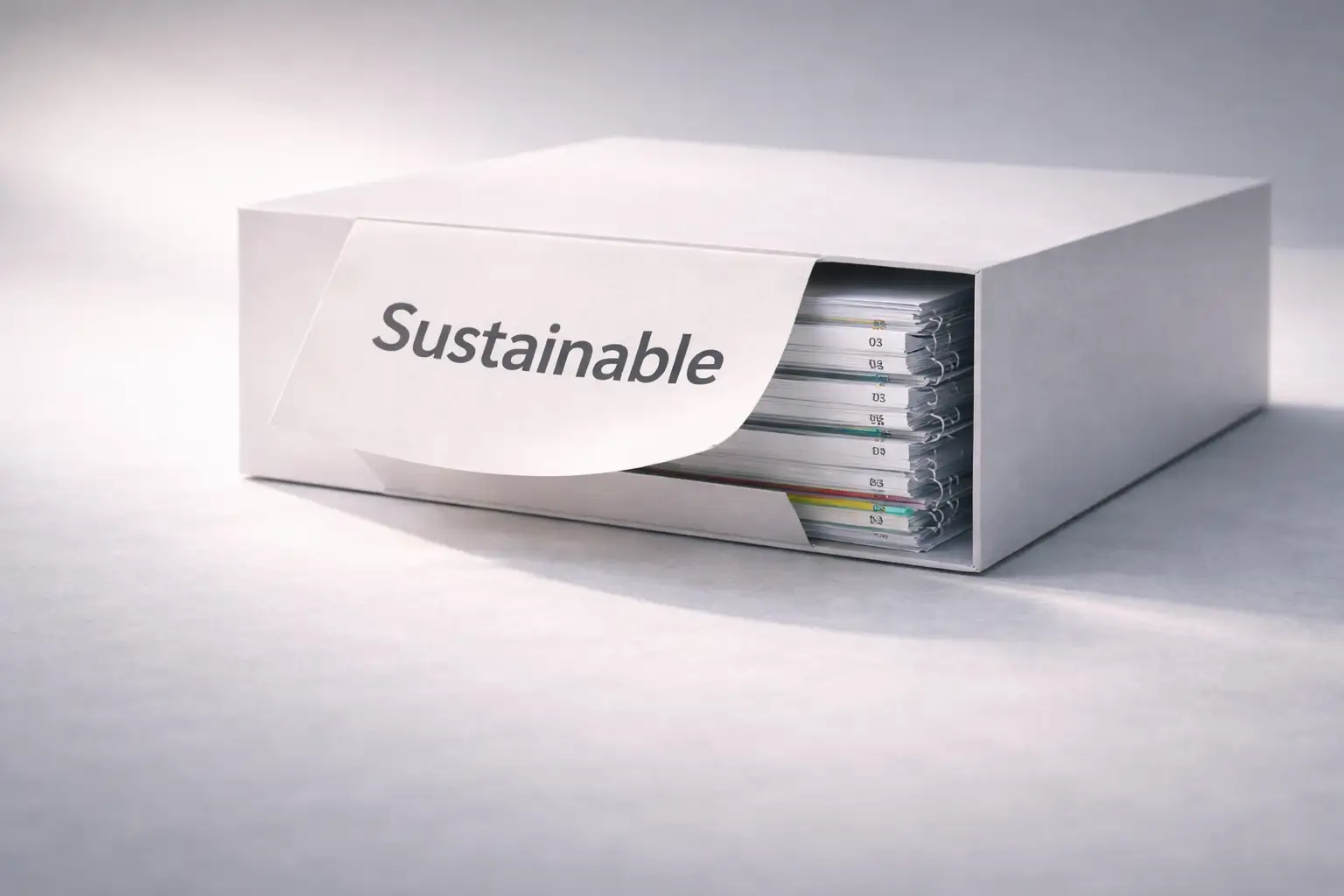
The EU is no longer treating environmental claims as a secondary marketing issue. With Directive (EU) 2024/825, the European framework strengthens protection against unfair practices and improves the information consumers receive in the green transition. Among other things, it directly targets generic environmental claims and sustainability labels that are not based on certification schemes or public authorities. In addition, Member States had to adopt and publish the necessary measures before March 27, 2026.
That makes this more than a regulatory milestone. For many companies, it is a clear market signal: it is no longer enough to phrase a claim well; what increasingly matters is the evidentiary base behind it, how it has been built, and whether it can withstand serious review by customers, certifiers, authorities, or third parties. That is exactly the kind of reading Averiun wants to build on the website: turning an external signal into a useful interpretation about evidence, traceability, and the real capacity to prove.
What really changes with this directive
The logic of the directive is fairly clear. The Council explains that the EU has adopted rules to protect consumers from misleading claims and improve the quality of the information they receive. Among the prohibited practices are generic environmental claims, for example expressions such as “ecological,” “environmentally friendly,” or similar, when recognized excellent environmental performance cannot be demonstrated. Misleading sustainability labels are also included when they are not based on a certification scheme or established by public authorities.
The key implication is not only legal. It is operational. Many organizations do have documents, certificates, supplier declarations, audits, or internal records. The problem appears when all of that is scattered across systems, actors, and points in time, and then a specific claim has to be supported coherently. That is where the gap opens up between having information and being able to demonstrate facts. This is precisely the problem the Averiun website should explain clearly: friction usually does not come from a total lack of data, but from the difficulty of turning it into a defensible evidentiary base.
The real problem: the claim usually comes before the evidence
In practice, many environmental claims depend on complex information chains. Suppliers, certifiers, procurement teams, quality teams, compliance, sustainability, and sometimes distributors or customers are all involved. Each actor holds part of the context. Each system preserves only part of the history. And each review requires the sequence to be reconstructed with a different level of detail.
That is why anti-greenwashing should not be read only as reputational pressure. It is also a sign that the market needs better evidence governance. Averiun’s editorial line fits naturally here: first the problem, then the reading, and only after that the company as a useful frame for understanding how to turn dispersed operational data into verifiable evidence for multi-actor traceability.
From declaration to proof
The most important thing about this directive is that it pushes the conversation toward a more demanding question: not only what a company says, but what it can sustain when someone asks for proof.
That shift matters especially in contexts where companies must demonstrate environmental attributes, traceability, origin, recycled content, or compliance with certain criteria without exposing more information than necessary. In that terrain, the issue is no longer simply whether documentation exists, but whether integrity, sequence, authorship, and context can be preserved around what is being claimed. The Averiun website should reinforce exactly that idea: proving is not the same as merely declaring, and sharing evidence is not the same as opening all data.
Why this matters for companies, not only lawyers
A frequent mistake is to read these rules as if they were only a matter for legal or regulatory departments. But the real impact appears much earlier. It affects how audits are prepared, how third parties are coordinated, how claims are validated, and how companies respond when a customer, certifier, or authority asks for concrete backing.
That is why this kind of change fits Averiun better as a regulatory article with an operational and verification-oriented reading, not as a flat legal summary. The internal guidance is clear on this: these pieces should translate the rule into practical impact, highlight the need to prove, and avoid both excessive legalese and alarmist tone.
What signal this sends to the market
The underlying signal is broader than the directive itself. The European market is moving toward a scenario in which sustainability claims need an increasingly clear, verifiable, and reviewable foundation. In that context, anything that helps organize historical records, sustain chain of custody, reduce audit friction, and share evidence with control across multiple actors becomes more important. That is exactly the thematic territory Averiun wants to occupy on the web: defensible traceability, verifiable evidence, claims, compliance, audits, and multi-actor coordination.
Where Averiun fits in this reading
Averiun does not need to appear here as a pitch. It works better as a natural conclusion. When the bar rises and a claim has to withstand review, the advantage no longer lies only in collecting documents, but in being able to structure a verifiable evidentiary base on top of existing systems and actors. That is where an infrastructure designed to prove without overexposing becomes meaningful: not as a cosmetic layer for communication, but as a more solid way to sustain facts, claims, and traceability before third parties.
The European consumer empowerment directive does not only harden the environment for certain environmental messages. It also leaves a deeper lesson: in sustainability, what can be said easily matters less and less than what can be sustained with evidence. And that difference, for many companies, is going to become increasingly decisive.

Written by
Sergio Lugo· CEO
Writes about traceability, operations, and how data veracity becomes a real competitive advantage.


