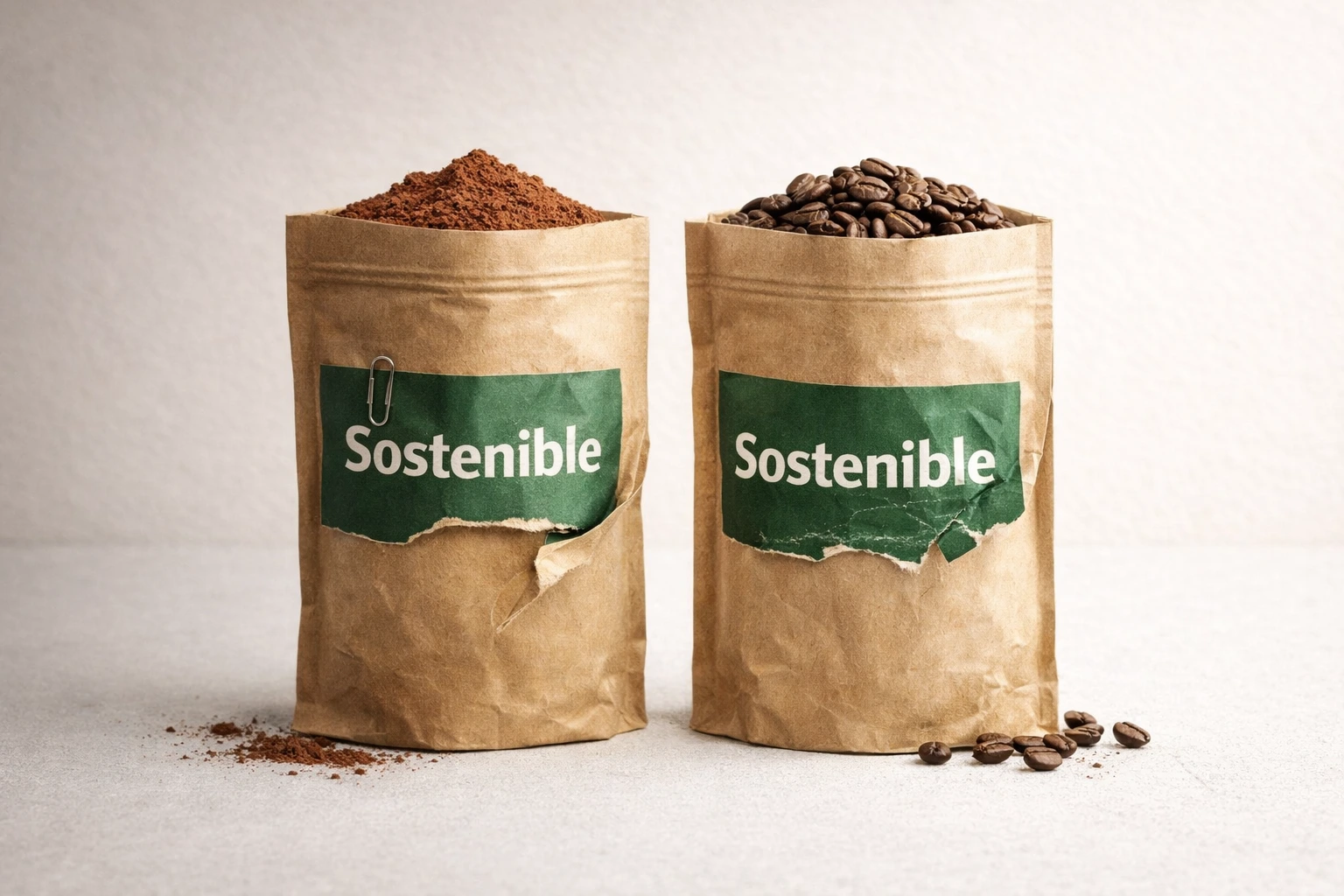
The recent action by the Dutch authority ACM on sustainability claims in coffee and cocoa goes far beyond a minor correction of labels. According to the ACM, major companies in the sector will modify sustainability claims and logos, and from September 2026 onward the use of proprietary sustainability logos will only be allowed under strict conditions.
The news matters because it confirms a deeper shift: the European market is leaving less room for broad, ambiguous, or hard-to-support expressions. Terms such as “sustainable” or “responsible” no longer work on their own if they do not make clear what concrete benefit is being claimed and on what basis it can be defended. The ACM had already been intensifying its scrutiny of the coffee and cocoa sector precisely because of the risk of unclear claims in an area that is especially sensitive due to its links to deforestation, human rights, and production conditions.
The problem is not only the language
It would be easy to read this as a matter of marketing or copywriting. But the real issue is more structural. When a regulator asks for a claim to be clear, specific, and verifiable, it is really forcing companies to review their ability to support what they communicate.
That is the key point for any organization working with sustainability, certification, or complex supply chains: the visible claim is only the tip of the iceberg. Underneath it are records, certificates, criteria, suppliers, lots, raw-material mixes, audits, and decisions about what can and cannot be said. When that base is diffuse or too fragmented, the problem is not only reputational. It also becomes operational, documentary, and governance-related.
Coffee and cocoa are a good example of a broader demand
The choice of sector is not accidental. Coffee and cocoa concentrate several of the hardest tensions to resolve in sustainability: multiple actors, international origin, complex social and environmental conditions, the use of certifications, and in some cases models such as mass balance that require companies to explain very clearly what is and is not being guaranteed. Several legal readings of the ACM’s move underline precisely that in these contexts, it is not enough to appeal to a general improvement of the system; the claim about the product itself must be understandable and clearly delimited.
That is why this should not be read only as a warning for food. It is a useful signal for any sector that depends on environmental or social claims, certifications, information provided by third parties, or multi-actor chains that are difficult to reconstruct. The pattern repeats itself: when the market demands more precision, the distance between having data and being able to demonstrate facts becomes visible.
What changes for companies
The practical consequence is not simply “be more careful in communication.” It is deeper than that. It forces companies to ask uncomfortable but necessary questions:
- what exactly each claim means
- what evidence supports it
- who generates or validates that evidence
- under what criteria it is preserved
- and what portion of it can be shared with third parties without exposing more information than necessary
In other words, the demand is not only for responsible communication, but for evidence infrastructure. A solid claim depends less and less on good wording and more and more on a traceable, coherent, and reviewable foundation. This is exactly one of the content directions Averiun should work on: explaining why proving is not the same as declaring, and why friction appears when data is dispersed across actors, systems, and documents.
Where Averiun fits
This is where Averiun’s logic fits naturally, without forcing the article into a pitch. The underlying problem is not an absolute lack of information, but the difficulty of turning dispersed information into verifiable evidence. In contexts like this, the value lies in being able to organize facts, records, and proof in a way that does not leave a claim dependent on implicit trust or last-minute reconstruction, but on a defensible historical record in front of third parties.
Applied to a case like coffee and cocoa, that means helping sustain claims with more discipline: reinforcing chain of custody, preserving the sequence of facts, reducing friction in audits, and sharing evidence selectively. It is not about “showing everything,” but about being able to demonstrate what is necessary with integrity and context. That distinction matters, because the market is increasingly not only penalizing overambitious messaging, but also the weakness of the proof behind it.
More than a correction of labels
The most useful reading of this news is this: the bar is rising. What could once be solved with broad wording and a reasonable narrative is starting to require finer traceability, better-defined criteria, and more defensible evidence. The ACM’s action does not close the debate; it gives it structure. And it reminds us of something likely to extend to more sectors: sustainability claims are no longer decided only on the packaging or the website, but in the quality of the evidence a company can sustain behind them.

Written by
Sergio Lugo· CEO
Writes about traceability, operations, and how data veracity becomes a real competitive advantage.


